
Blogs
How to Select Good Investment Options
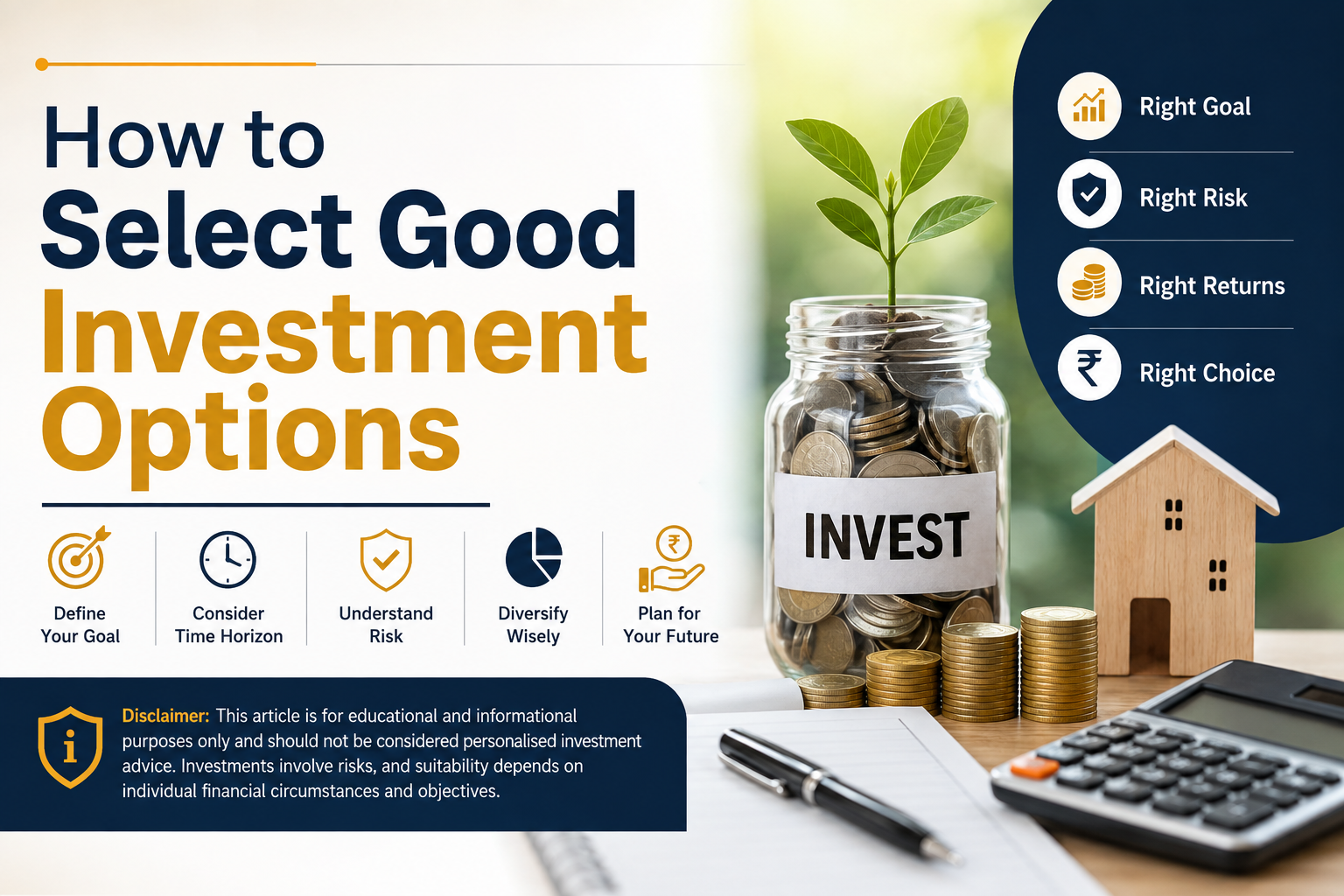
Selecting good investment options is an important part of financial planning. However, there is no single investment that is “best” for everyone. An investment suitable for a young professional may not suit a retired person, a business owner or someone saving for a short-term goal. Therefore, instead of simply looking for the highest returns, investors should focus on selecting investments that match their financial goals, investment horizon, risk capacity, liquidity needs and tax situation.
Some important factors to consider.
1. Start With Your Financial Goal
Before investing, ask yourself: Why am I investing this money?
Your goal may be retirement, children's education, buying a house, wealth creation, generating
regular income, or building an emergency fund.
Once your goal is clear, estimate how much money you need and when you will need it.
For example, money required after two years should usually be approached differently from
money being invested for retirement after 20 years.
2. Consider Your Investment Horizon
Your investment horizon is the period for which you can remain invested.
Generally, short-term requirements need greater focus on liquidity and stability. Long-term goals may allow investors to consider investments with greater growth potential, although they may also experience temporary fluctuations.
You can broadly divide your requirements into:
ï‚· Short-term: Money needed in the near future
ï‚· Medium-term: Money needed after several years
ï‚· Long-term: Goals such as retirement and long-term wealth creation
Matching the investment with the time horizon can reduce the possibility of being forced to sell at an unsuitable time.
3. Understand the Risks
Every investment involves some level of risk. Before looking at expected returns, understand what risks are involved.
These may include market risk, credit risk, interest-rate risk, liquidity risk, inflation risk, and concentration risk.
Before investing, ask:
ï‚· Can the value of my investment fall?
ï‚· How much volatility can I expect?
ï‚· How easily can I access my money?
ï‚· What factors can affect returns?
ï‚· Could I lose part of my capital?
Higher potential returns may involve greater uncertainty. Therefore, do not select an investment based only on attractive historical performance.
4. Evaluate Your Risk Capacity
Your willingness to take risk and your ability to take risk may be different. You may be comfortable with market fluctuations but still not be financially able to take significant risks if the money is required soon.
Your risk capacity depends on factors such as:
ï‚· Income stability
ï‚· Existing savings
ï‚· Financial dependents
ï‚· Loans and liabilities
ï‚· Emergency fund availability
ï‚· Investment horizon
ï‚· Financial responsibilities
A good investment option should match both your financial capacity and your comfort with risk.
5. Look Beyond Advertised Returns
A high return does not automatically make an investment good.
You should also consider taxes, costs, charges, and inflation. These factors can affect the amount of return you ultimately retain.
When comparing investment options, consider:
ï‚· Potential return
ï‚· Risk involved
ï‚· Tax treatment
ï‚· Investment costs
ï‚· Exit charges
ï‚· Liquidity
ï‚· Inflation impact
The objective should be to focus on post-tax, risk-adjusted returns.
6. Check Liquidity
Liquidity means how easily you can access your money.
Some investments can be converted into cash quickly, while others may have lock-in periods or restrictions.
A good financial plan should separate money required for emergencies, short-term goals and long-term wealth creation.
7. Diversify Your Portfolio
Putting all your money into one investment can create unnecessary concentration risk.
Ten investments with similar risks may still create a concentrated portfolio.
Effective diversification aims to balance different needs, including:
ï‚· Growth
ï‚· Stability
ï‚· Liquidity
ï‚· Income
The appropriate level of diversification depends on your personal financial situation and objectives.
8. Do not t Rely Only on Past Performance
Past returns are useful for analysis, but they do not guarantee future performance.
An investment may have performed exceptionally well because of favourable conditions that may not continue.
Instead of looking only at recent returns, consider its longer-term performance, consistency, risks, costs and investment strategy.
9. Understand What You Are Investing In
Never invest in something you do not understand. Before investing, try to know:
ï‚· How does it generate returns?
ï‚· What are its major risks?
ï‚· How long should you remain invested?
ï‚· How easily can you access the money?
ï‚· What charges are involved?
ï‚· How is it taxed?
10. Avoid Tips and Market Hype
Investment decisions are often influenced by friends, relatives, social media and market trends.
Also be cautious about claims of guaranteed or unusually high returns.
Instead of following market hype, return to the basic questions:
Does this investment suit my goal?
Can I take its risks?
How long can I remain invested?
11. Check Quality and Credibility
Before investing, review the quality and credibility of the investment. Depending on the type of product, consider factors such as:
ï‚· Regulatory framework
ï‚· Track record
ï‚· Financial strength
ï‚· Credit quality
ï‚· Transparency
ï‚· Costs
ï‚· Risk disclosures
Higher returns should never prevent you from carrying out proper due diligence.
12. Review Your Investments Regularly
Selecting an investment is not a one-time exercise.
Your income, financial goals, family responsibilities and risk capacity can change over time.
Check for changes in your goals, asset allocation, liquidity requirements, risk capacity and tax situation.
However, regular review does not mean frequent buying and selling. Avoid making changes based only on short-term market movements.
Final Thoughts
A suitable investment should match your financial goals, investment horizon, risk capacity, liquidity requirements, diversification needs and tax considerations.
The best investment is not necessarily the most popular or the one that performed best recently. A good investment is one that serves a clear purpose and fits appropriately into your personal financial plan.
By focusing on suitability, risk, diversification, liquidity and tax efficiency, you can make smarter and more informed investment decisions.
Disclaimer: This article is for educational and informational purposes only and should not be considered personalised investment advice. Investments involve risks, and suitability depends onindividual financial circumstances and objectives.
TRENDING POST
RECENT POSTS
How to Select Good Investment Options
Aug 25, 2026
How to Build a Customized Investment Portfolio
Aug 21, 2026
NEWSLETTER
Subscribe my Newsletter for new blog posts. Stay updated from your inbox!
Leave a Comments