
Blogs
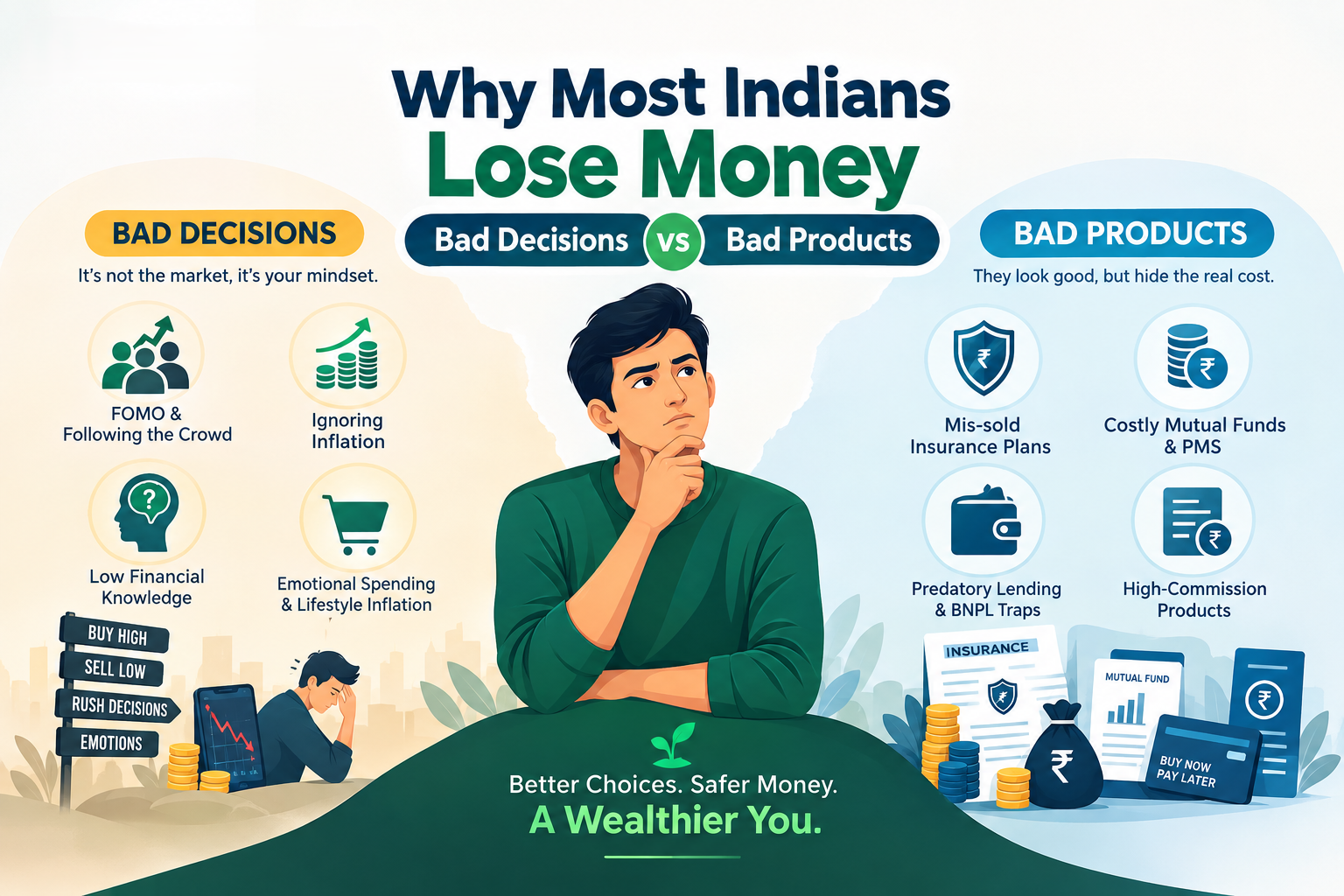
Why Most Indians Lose Money: Bad Decisions vs Bad Products
In India, some people trust gold and land. Others try to get rich overnight with crypto or new trading apps.
Here is the honest truth. Most Indians do not lose money because the system is against them. They lose money because they make poor money decisions, or because they buy products that were sold to them in a misleading way.
At Easy2BeWealthy, we believe you do not need magic to build wealth. You only need to avoid common mistakes. Let's look at why these money mistakes happen in India and how you can keep your money safe.
Quick answer: Indians lose money mainly because of three things. First, emotional investing like FOMO. Second, low financial knowledge. Third, high-commission products like endowment plans, expensive funds, and unregulated schemes.
The Great Indian Money Paradox
India is one of the fastest growing economies in the world. Still, managing personal money feels confusing for many people. Surveys suggest that many Indian households have no emergency fund and no proper life insurance or income protection.
Why does this happen? Are banks selling the wrong things? Or are we making quick decisions ourselves? The answer is both.
If you understand the difference between a bad decision (your mistake) and a bad product (the product's fault), you have already solved half the problem.
Part 1: The Trap of Bad Decisions
A bad financial decision is a choice you make without thinking, in a rush of emotion, or with half the facts. It is a mistake in your behaviour, not in the market.
1. Following the Crowd and FOMO
The biggest reason people lose money in the stock market is FOMO, which means Fear Of Missing Out. A friend says, "That small-cap stock gave 2x returns!" and suddenly your brain stops thinking.
Investing without research is like gambling. Many people enter the market when it is already high, buy at peak prices, and sell in panic when prices fall. This is "Buy High, Sell Low." It is not the product's fault. It is a timing mistake. The market is neutral, and your results depend on your plan.
What to do: Stay disciplined. Start a Systematic Investment Plan (SIP) in mutual funds. A SIP averages out your buying cost and removes the need to make emotional choices. Read our article Smart SIP Strategies to learn how to stay consistent.
2. Ignoring Inflation
Many Indians are proud to be "savers." They keep all their money in a savings account or Fixed Deposit (FD). It is safe, yes. But does it beat inflation?
Say inflation is 6% and your FD pays 7%. Your real return is only 1%. After tax, you may even be losing buying power.
This is a bad decision because we think "safe" means "good." In truth, safety without growth slowly eats your wealth.
What to do: Spread your money across different assets. Equity mutual funds, Gold ETFs, and real estate can help you beat inflation over the long term. Learn what "real rate of return" means.
3. Low Financial Knowledge
Very few Indians understand compound interest, asset allocation, or tax planning. So they follow WhatsApp forwards and YouTube influencers.
Making choices with half knowledge invites trouble. For example, someone may buy a ULIP (Unit Linked Insurance Plan) thinking it is a great investment, without checking the charges. The product may not be bad in itself, but the lack of understanding made it a bad decision.
What to do: Keep learning. Follow trusted sources. If you cannot explain an investment to a 10-year-old, do not put your money in it. To begin, read our guide Understanding Mutual Funds.
4. Emotional Spending and Lifestyle Inflation
When your salary grows, your spending grows too. This is called lifestyle inflation. A luxury car on EMI, a new phone every year, and frequent eating out all reduce the money you can invest.
For middle-class Indians, this is often the biggest block to building wealth.
What to do: Make a budget. Try the 50-30-20 rule: 50% for needs, 30% for wants, and 20% for savings and investing. Pay yourself first, and spend what is left.
Part 2: The Trap of Bad Products
If bad decisions come from inside you, bad products are traps from outside. They look shiny, but they carry hidden costs, poor transparency, or the wrong incentives.
1. Insurance Policies Sold the Wrong Way
Insurance is for protection, not for investment. But many agents sell it as an investment. They push endowment plans and money-back policies because they earn a big commission, not because the plan is good for you.
These plans often give only 4-5% returns and lock your money for many years. If you exit early, you can lose a big part of your money. For wealth creation, this is a poor product.
Better option: Buy a pure Term Life Insurance plan and invest the rest of your money in the market. Term plans are cheap and give high cover. If you already have a policy, check whether it is a term plan or an investment plan. If you have not reviewed it in a while, do it now. See our article How to Review Your Life Insurance Policy.
2. Costly Mutual Funds and PMS
Not all mutual funds are the same. Some charge a very high expense ratio or an exit load. Portfolio Management Services (PMS) need a high minimum investment and charge performance fees that eat into your gains.
If a fund stays behind its benchmark even before you count the fees, it is a bad product. People also often buy last year's top performer, which may be next year's worst.
What to do: Look for low-cost index funds, or active funds with a steady track record. Check the net return after fees, not the gross return.
3. Predatory Lending and BNPL Traps
Buy Now, Pay Later (BNPL) schemes and instant personal loans are everywhere. They are convenient, but they often have high interest rates and hidden fees. If you miss a payment, interest grows fast and you can fall into a debt trap.
For people who struggle with spending discipline, these are dangerous products. They encourage overspending and can hurt your credit score.
What to do: Use your credit card wisely and pay the full bill every month. Avoid BNPL for non-essential things. If your debt is high, think about a consolidation loan with a lower interest rate.
4. Crypto and Unregulated Schemes
Crypto has attracted many new investors. The technology has potential, but many crypto projects are scams or very speculative. In some small towns, unregulated chit funds and Ponzi schemes still promise returns that are too good to be true.
These are high-risk products with little regulatory protection. Losses here often come more from the product's weakness than from the user's mistake.
What to do: Stay with regulated options like SEBI-registered mutual funds, stocks, and bonds. If you still want to try crypto, use only a small part of your money, an amount you can lose without losing sleep.
When Bad Decisions Meet Bad Products
The worst damage happens when a bad decision pushes you toward a bad product.
- Example 1: You get scared by market ups and downs (bad decision) and buy a ULIP (bad product). Result: poor returns and weak insurance cover.
- Example 2: You want to get rich overnight (bad decision) and buy a penny stock from a Telegram tip (bad product). Result: your whole money can go to zero.
To break this cycle, you need both financial discipline and product awareness.
How to Avoid Losing Money: A Simple Plan
1. Set Clear Financial Goals
Know why you are investing. Is it for retirement, your child's education, or a house? Different goals need different asset mixes. For short-term goals, choose safety (debt instruments). For long-term goals, take more risk (equity).
2. Build an Emergency Fund
Life is unpredictable. You may lose your job, face a medical emergency, or need to repair your vehicle. Keep 6 to 12 months of expenses in a liquid fund or a high-interest savings account. This stops you from selling investments at a loss during a crisis.
3. Get Enough Protection
Term life insurance is the base. Also think about health insurance and income protection. If you fall sick or become disabled, your income may stop but your bills will not. Income protection helps your family keep its lifestyle. If you have not reviewed your policies recently, this is a good time to do so.
4. Diversify Your Portfolio
Do not put all your eggs in one basket. A balanced portfolio can include:
- Equity: for growth (mutual funds, stocks)
- Debt: for stability (FDs, bonds, debt funds)
- Gold: to protect against inflation (Gold ETFs)
- Real estate: for a physical asset, if your budget allows
Diversification lowers risk. Read our guide Asset Allocation Strategies for more detail.
5. Review and Rebalance Every Year
Markets change, and so does your life. Review your portfolio once a year. If one asset has grown or fallen a lot, rebalance it. This keeps your portfolio in line with your risk level.
6. Take Professional Advice Wisely
If you are confused, meet a fee-only financial planner. Be careful with commission-based agents, because their advice can be biased. A fee-only advisor charges for their time and skill, so their guidance is more neutral.
The Role of Technology in Smart Investing
Technology now helps you avoid bad decisions and spot bad products. Apps show real-time data, compare expense ratios, and track your portfolio. Use these tools.
But remember, technology is only a tool. It cannot replace financial knowledge. You must understand what the data means. Do not follow algorithms blindly.
Conclusion: Take Control of Your Financial Future
Losing money is not unavoidable. When you understand the difference between bad decisions and bad products, you can move ahead with confidence.
Remember:
- Bad decisions are in your control. Learn more, manage your emotions, and stick to your plan.
- Bad products can be avoided with research. Look for transparency, low costs, and regulation.
At Easy2BeWealthy, our mission is to help you make smarter choices. Wealth is not built overnight. It is a long race. Review your policies, build your emergency fund, and keep learning.
Start today.
Frequently Asked Questions (FAQs)
Q1: What is the biggest reason Indians lose money?
The biggest reasons are low financial knowledge, emotional investing (FOMO), and buying high-commission, low-return insurance products.
Q2: Are mutual funds safe?
Mutual funds carry market risk, but they are regulated by SEBI. Choosing low-cost, diversified funds and investing for the long term reduces risk a lot.
Q3: Should I buy a ULIP or term insurance?
For most people, it is better to buy term insurance and invest separately. ULIPs can have higher charges, and they often give only average results in both protection and growth.
Q4: How can I improve my financial literacy?
Read trusted blogs like Easy2BeWealthy, follow SEBI guidelines, and take online courses on personal finance. Avoid advice from unverified social media sources.
Q5: Is gold a good investment?
Gold is a good hedge against inflation and a falling rupee, but it does not give regular income. Keep only about 5-10% of your portfolio in gold, and prefer Gold ETFs over physical gold.
Disclaimer: This article is for educational purposes only and is not investment advice. Please talk to a SEBI-registered advisor before making any financial decision.
TRENDING POST

RECENT POSTS
.webp)


How to Build a Customized Investment Portfolio
Aug 21, 2026
NEWSLETTER
Subscribe my Newsletter for new blog posts. Stay updated from your inbox!
Leave a Comments